Hospitality
Front Desk Design Trends Worth Planning Around
Front desk trends often arrive as a picture: a curved counter, a dramatic wall, a row of check-in pods or a glowing logo.
On this page
- 1. Front Desks Are Becoming Service Hubs
- 2. Long Counters Are Being Broken Into Smaller Interactions
- 3. Technology Is Being Integrated More Quietly
- 4. Digital and Human Service Are Sharing the Lobby
- 5. Accessibility Is Being Integrated Into the Composition
- 6. Materials Are Becoming Warmer but More Durable
- 7. Lighting Is Becoming More Purposeful
- 8. Branding Is Becoming More Architectural
- 9. Staff Workflow Is Receiving More Attention
- 10. Privacy Is Shaping Station Spacing
- 11. Curves Are Being Used More Selectively
- 12. Modular Construction Is Supporting Change
- 13. Sustainability Is Being Considered Through Longevity
- 14. Front Desks Are Becoming Less Massive
- Trends to Approach Carefully
- How to Evaluate a Front Desk Trend
- Common Front Desk Planning Mistakes
- Frequently Asked Questions
- Planning a New Front Desk?
Front desk trends often arrive as a picture: a curved counter, a dramatic wall, a row of check-in pods or a glowing logo.
The picture does not show the employee trying to refill a printer, the guest waiting with luggage or the cable bundle added after opening.
The front desk ideas most likely to last are not tied to one finish or shape. They make service easier, give staff better tools, reduce visual clutter and allow the furniture to adapt as technology changes.
This guide looks at current front desk design directions through a practical question: which ones will still help the operation after the style changes?
1. Front Desks Are Becoming Service Hubs
The front desk may support more than arrival and departure.
Depending on the property, it can handle:
- Check-in and check-out
- Payments
- Keys and access
- Concierge questions
- Package pickup
- Transportation
- Resident or tenant service
- Visitor badges
- Security coordination
The trend is not simply toward a larger desk. It is toward clearer service zones.
One position may handle routine arrivals. Another may support longer questions. A separate surface may provide forms or self-service.
Identify the services before deciding how many counter sections the desk needs.
2. Long Counters Are Being Broken Into Smaller Interactions
Separate stations or pod-style desks can make the interaction feel more personal.
Potential benefits include:
- Staff can step beside the guest
- Individual stations are easier to identify
- The lobby may feel more open
- Different services can occupy separate positions
Potential tradeoffs include:
- Less shared storage
- More visible equipment
- Additional power and data coordination
- Difficult staff movement
- Reduced security boundaries
A traditional long counter still works well when shared equipment, high transaction volume or secure separation is important.
Do not choose pods because they look less formal. Choose them when they fit the service model.
3. Technology Is Being Integrated More Quietly
Computers, payment devices, key encoders, scanners and charging equipment are not disappearing.
The design direction is toward making them less visually dominant through:
- Concealed cable routes
- Recessed equipment zones
- Integrated power
- Monitor placement
- Charging inside cabinets
- Service panels
- Flexible equipment openings
The furniture should not be built so tightly around one device that replacement becomes difficult.
Provide ventilation and access for maintenance. Hidden equipment still needs to be restarted, refilled and removed.
4. Digital and Human Service Are Sharing the Lobby
Mobile check-in, kiosks and online service can handle routine transactions. Guests still need staff for exceptions, questions and personal assistance.
Oracle Hospitality research reported strong traveler interest in using mobile devices to manage hotel activities while also describing a mixed future in which digital and personal service coexist. Oracle’s hospitality research supports planning for more than one service path.
Front desk design may now need to coordinate:
- Staffed service
- Mobile-key assistance
- Kiosks
- Quick questions
- Complex transactions
Make each path easy to understand. A guest should not join the longest line merely to resolve a minor digital problem.
5. Accessibility Is Being Integrated Into the Composition
Accessible service should not look like an attachment added after the main design.
Plan:
- Service-counter height and length
- Approach type
- Clear floor space
- Accessible route
- Equipment
- Equivalent service
- Communication
The accessible position should be visually and operationally part of the desk.
Do not use it for brochures, displays or temporary storage.
Federal, state and local requirements should be confirmed by qualified professionals responsible for the project.
6. Materials Are Becoming Warmer but More Durable
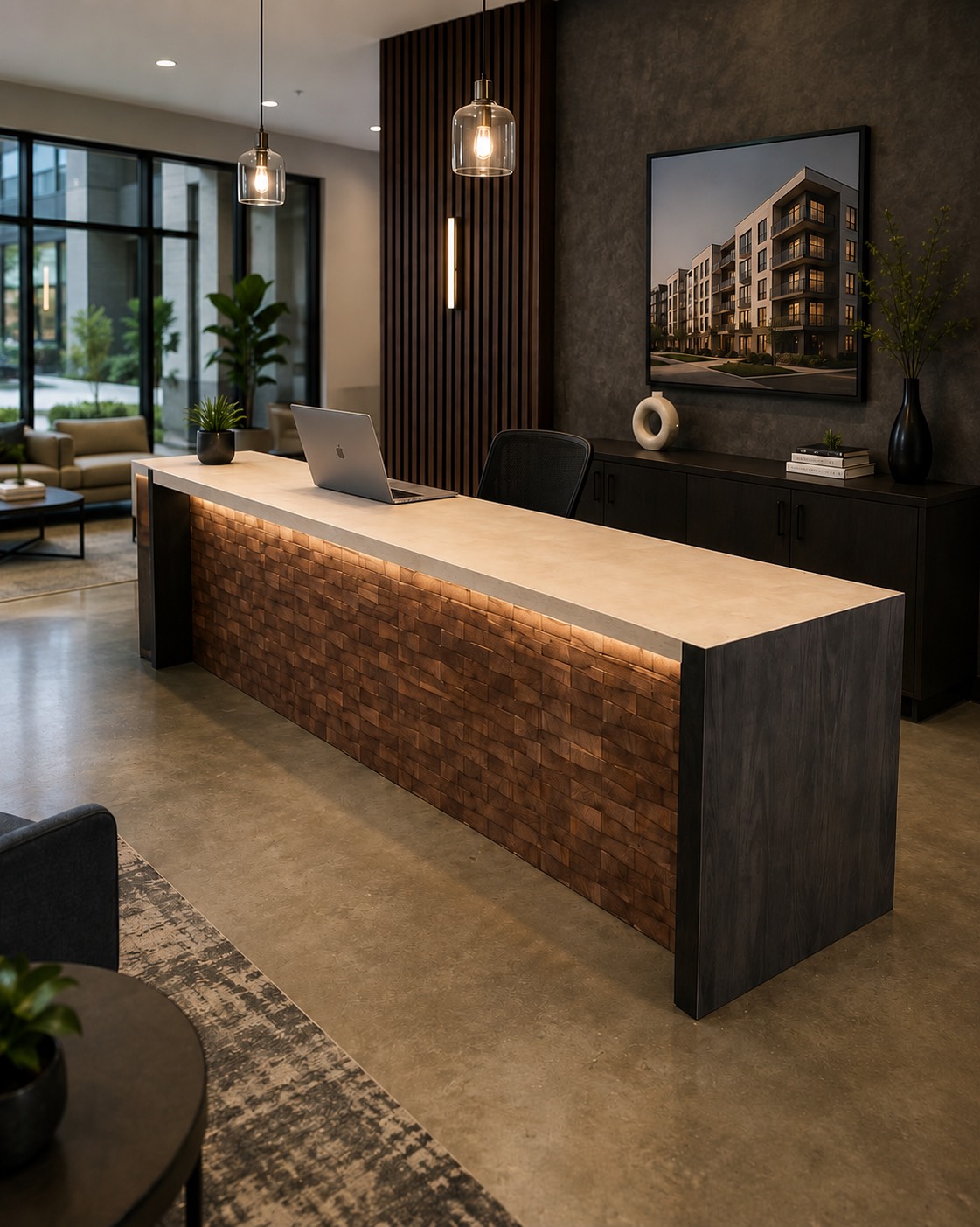
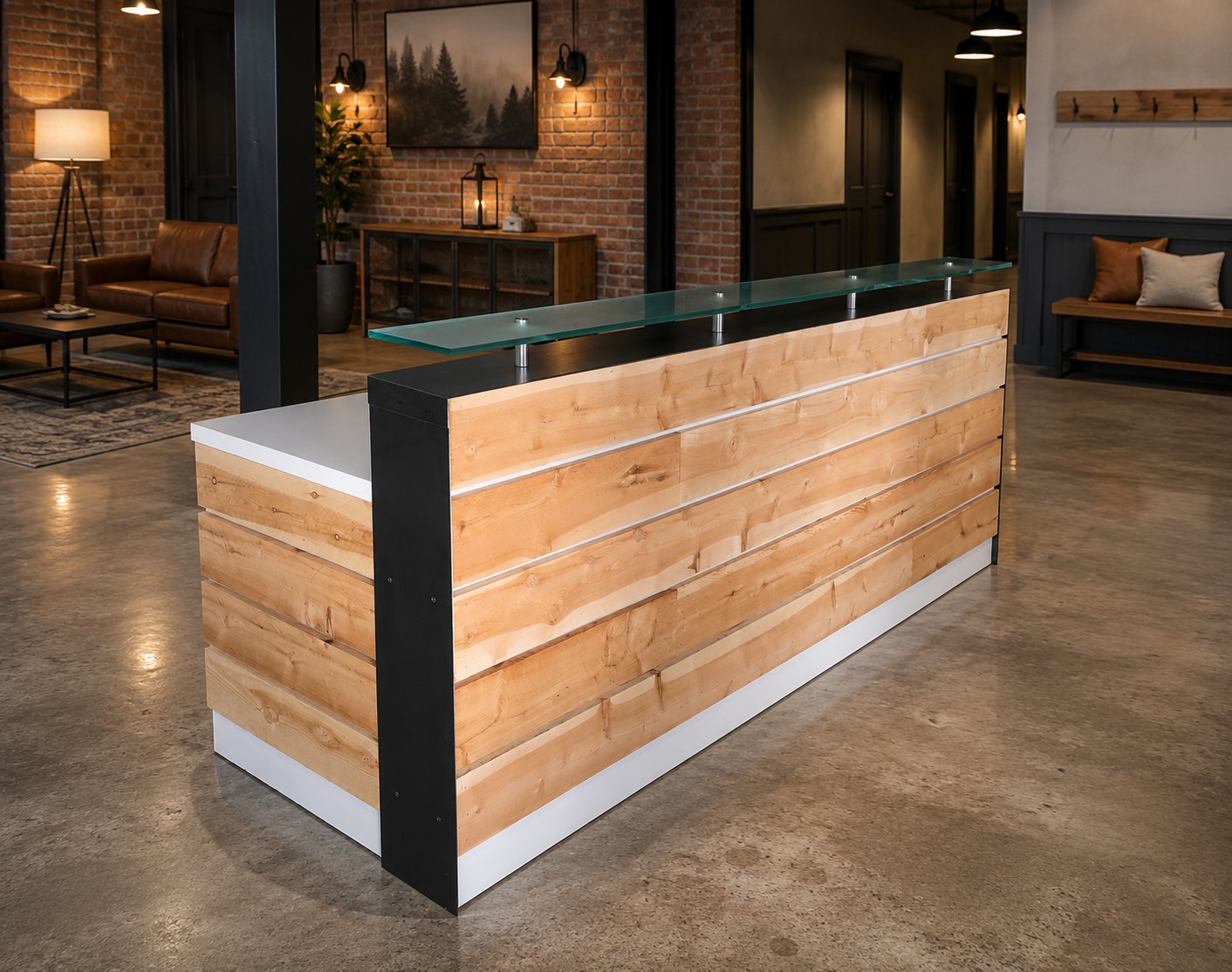
Wood tones, textured panels, stone-like surfaces and restrained metal details can make a public counter feel less institutional.
The practical shift is toward warmth without sacrificing commercial performance.
Evaluate:
- Cleaning
- Luggage or cart impact
- Moisture
- Fingerprints
- Edge damage
- Repairability
- Replacement
A residential-looking finish may not tolerate public use. A durable commercial material can still feel warm when the color, scale and detailing are appropriate.
Limit the palette. Too many materials make a desk harder to repair and visually date faster.
7. Lighting Is Becoming More Purposeful
Integrated lighting may:
- Identify the desk
- Illuminate a logo
- Highlight a material
- Improve the work surface
- Support wayfinding
It can also create glare, expose fingerprints or become a maintenance problem.
Plan:
- Color temperature
- Brightness
- Controls
- Driver access
- Replacement
- Daylight conditions
Avoid lighting every edge simply because LED tape makes it possible.
Use light to clarify the desk’s role and support the room.
8. Branding Is Becoming More Architectural
Logos are moving away from temporary applied graphics toward dimensional, illuminated or material-integrated treatments.
Brand identity can also come through:
- Shape
- Color
- Local materials
- Artwork
- Signage
- Language
The strongest result does not require the largest logo.
Branding should help people identify the service point and connect it to the surrounding environment.
Avoid letting decorative branding consume the storage, work surface or budget needed for daily operation.
9. Staff Workflow Is Receiving More Attention
The public face of the desk may drive the concept, but the employee side determines whether it works.
Plan:
- Workstation spacing
- Chair movement
- Shared equipment
- Printer access
- Storage
- Staff entry
- Supervisor assistance
- Sightlines
- Security
Employees should be able to reach frequently used items without turning away from the visitor or crossing behind another workstation.
Test the desk with real tasks before approving it.
10. Privacy Is Shaping Station Spacing
Front desks may handle names, payments, identification, room numbers, account information and access credentials.
Design can support privacy through:
- Screen angles
- Distance between positions
- Acoustic separation
- Document storage
- Queue direction
- A separate place for longer conversations
Avoid placing the next guest directly behind the active transaction.
Privacy procedures remain essential, but the furniture and lobby should make good procedures easier.
11. Curves Are Being Used More Selectively
Curved desks can:
- Respond to lobby circulation
- Soften a large open space
- Serve several approach directions
- Create a distinctive focal point
They also affect:
- Fabrication
- Countertop cost
- Cabinet geometry
- Storage efficiency
- Equipment placement
Use a curve when the room or traffic benefits from it.
A straight or gently angled desk may provide better function with less complexity.
12. Modular Construction Is Supporting Change
Front desks may need to adapt when:
- Technology changes
- Staffing changes
- Services move
- A lobby is renovated
- The furniture must pass through restricted doors
Modular planning may include:
- Sectional fabrication
- Removable equipment panels
- Adjustable shelves
- Replaceable feature panels
- Reconfigurable workstations
Modular does not have to mean temporary-looking.
Plan seams, connections and finish transitions intentionally.
13. Sustainability Is Being Considered Through Longevity
Sustainability discussions can become focused on material labels while ignoring how long the furniture remains useful.
Practical questions include:
- Can damaged parts be repaired?
- Can equipment be replaced?
- Can panels be refinished?
- Can the desk adapt to staffing changes?
- Can materials be sourced again?
- Is the design likely to be removed when the visual trend changes?
A durable, adaptable desk that remains in service may provide more value than one built around a short-lived feature.
Ask manufacturers and project professionals for relevant material documentation when sustainability requirements are part of the project.
14. Front Desks Are Becoming Less Massive
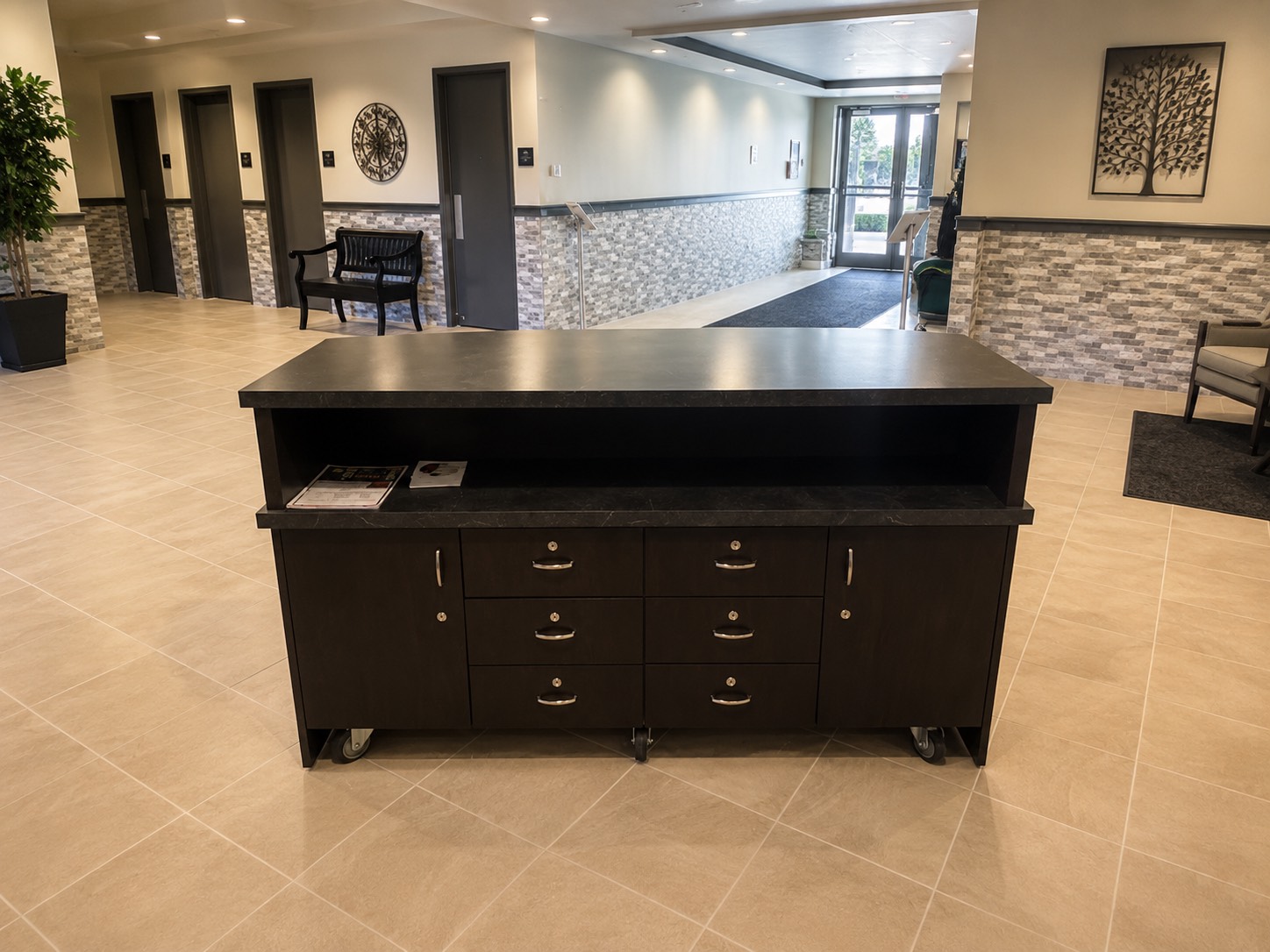
Large counters can establish presence, but they can also make staff feel distant.
Designers are reducing visual mass through:
- Openings between stations
- Recessed bases
- Controlled counter thickness
- Lighter materials
- Shorter runs
- Rounded corners
- Lower adjacent service points
Less mass does not mean less storage or weaker construction.
It requires a more deliberate interior plan.
Trends to Approach Carefully
Lighting on every edge
It can become distracting and difficult to maintain.
Oversized logos
Branding should support identification without overpowering the lobby.
Pods without storage
Separate stations may push equipment and supplies into view.
Furniture built around one device
Technology will change before the furniture reaches the end of its useful life.
Residential materials in commercial use
Appearance does not guarantee durability.
Curves without a traffic reason
Complexity should solve a problem.
Fully digital service without staff support
Exceptions still need a clear, accessible human path.
Open layouts without privacy
Screen and conversation exposure should be addressed early.
How to Evaluate a Front Desk Trend
Before adopting an idea, ask:
- Does it improve visitor service?
- Does it support staff workflow?
- Does it fit the room and traffic?
- Can it be maintained?
- Can equipment be replaced?
- Does it support accessibility?
- Will it still work if staffing changes?
- Is the cost tied to useful function?
- Can damaged components be repaired?
- Would we choose it without seeing the marketing photograph?
If the idea cannot answer those questions, it may be decoration rather than an improvement.
Common Front Desk Planning Mistakes
Starting with the feature wall
Define service, traffic and workstations first.
Ignoring the employee side
Storage, equipment and movement determine daily performance.
Adding technology too late
Power, data, ventilation and service access belong in the original plan.
Treating accessibility as a visual detail
The complete route, counter and service must be reviewed.
Choosing too many finishes
A limited material palette usually ages better.
Hiding maintenance access
Lighting and equipment must remain serviceable.
Copying a desk from another property
The same shape may not fit your workflow or lobby.
Frequently Asked Questions
What are current front desk design trends?
Current directions include smaller service zones, quieter technology integration, mixed digital and staffed service, accessible interaction, warmer durable materials, purposeful lighting, architectural branding, privacy and modular construction.
Are front desk pods better than one long counter?
Pods can create personal interactions and open the lobby. Long counters provide shared storage, security and efficient staff support. The right choice depends on the operation.
Are curved front desks still popular?
Curves remain useful in open lobbies and multi-directional traffic. They should be chosen for spatial benefit rather than novelty.
How can technology be hidden in a front desk?
Use planned cable routes, equipment recesses, charging cabinets and service panels. Maintain ventilation and access for replacement.
Should a front desk include integrated lighting?
Lighting can identify the desk or highlight branding. Use it selectively and plan controls, drivers and maintenance access.
What materials are best for a modern front desk?
Choose commercial-grade materials based on cleaning, impact, moisture, repairability, appearance and expected lifespan.
How can a front desk provide privacy?
Angle screens, space positions appropriately, direct queues carefully, secure documents and provide a separate place for longer conversations.
What makes a front desk accessible?
Accessibility depends on the applicable counter, approach, clear floor space, route, equipment and equivalent service requirements. Qualified professionals should review the complete project.
Is a modular front desk worth considering?
Modular construction can simplify delivery, equipment replacement, repairs and future changes when the sections are planned as one coordinated design.
When is a custom front desk the right choice?
Custom design is useful when the room, workflow, equipment, accessibility, storage or brand requirements cannot be supported effectively by standard furniture.
Continue planning
Related Hospitality Guides